
Tuesday, 16 December 2014

Tuesday, 9 December 2014
David Kolb
 David Kolb
David A. Kolb is an American educationalist who was born in 1939 and is well known for developing
his idea of a learning cycle, which he published in 1984.
When learning something new we tend to
remember and it normally has more of an effect on us if we, ourselves are
actively involved with the process. Now a days teachers try to move away from
the traditional way of learning and use experiential
learning as it has more of an effect on their students, not only young students
but people from all ages.
The first step is being able to
recognize you have the experience, and then having the right tools to
reflective upon it. Kolb’s looked further into learning experience and
developed his own learning cycle:

Step 1- Active Experimentation- David Kolb’s thought
it was useful if the learner was involved with every step of the cycle, which
included the planning of the experience. Making sure you have complete
understanding of what was going to happen and breaking each step down will help
the learning experience.
Step 2-Concrete Experience- Making
sure the learner is completely involved in the experience, with watching,
doing, and making notes, or records depending on what situation they’re in.
Step 3- Reflective Observation- The
most important stage of the cycle is reflecting on what happened. Knowing why
it happened? How it happened? What didn’t happen? What you could have been done
differently? Did anything go wrong? Although this is the most important stage
of the cycle it is definitely the hardest, the deeper you reflect the deeper the
meaning of the experience.
Step 4- Abstract
Conceptualisation- The last stage is a conclusion of what has happened and the
theory behind it all. This stage can easily be missed out but is very helpful
and can also lead you to your next step.
Kolb’s learning cycle is very
helpful especially in the dance world, and very interesting to think about when
I’m teaching my classes. I have recently been experimenting in class on which
is the best way to teach and have an effect on children. In the last few weeks
I have been teaching my classes their pantomime dances so they have all been
learning new steps to put in their new routines. I have noticed the majority of
children find tap dances the hardest to pick up and get to grip with (I put this
down to tap normally being performed to a faster pace music track so there are
more steps to learn, and when learning tap it can sometimes feel the footsteps
are very small and certain steps can look very alike to each other.) Breaking
the dance into sections helps a lot, so they do not feel overwhelmed with
learning a million of steps all at once. Having different methods of teaching
makes it more interesting as well, my Grade 3 tap class are most effective when
I challenge them to watch me perform a certain amount of steps and seeing if
they can repeat it straight after me, they like to think of this as a game, and
I’m testing them which makes them focus a lot more and is fun for them too.
You can definitely lose their
concentration if they stand still for too long I find, they prefer to be moving
and active and not standing around discussing or watching for too long,
otherwise their minds tend to wonder especially for the younger ages, making
sure they are focus on what you are trying to teach them is crucial. This
brings me back to what David Kolb also believed that being actively involved
has more of an effect on us when learning something new.
When it comes to older students normally
around the age of 13-16 they like to know you can dance too, and I find girls
really enjoy classes if you show them first full out, especially with kicks or
leaps etc… If you impress them they normally want to impress you and want to be
able to perform a step like that, everybody wants to wow the audience or their
friends it is just finding them the motivation or drive to practice. Boys and
girls are very different in this way I find, boys are really competitive and
are not at all concern about making a fool of themselves or falling over, where
girls on the other hand are still competitive but hide it more and dislike
people watching if they haven’t come to grips with a step.
I also understand everyone has a
different learning style and all prefer different ways to be taught, some of
use like being active and involved whereas some of us prefer to observe, use
the trial and error method and just try out different things until they find
the right path or some people like to think and work it out in their heads
before doing so. These four ways of learning are called; Concrete Experience,
Reflective Observation, Active Experimentation and Abstract Conceptualisation.
It does not matter which learning style suits you best but knowing which style
has more of an effect on you will be a very useful tool in life.
Social Networking
Social
Networking
- Twitter
Twitter was
designed in March 2006 by Jack Dorsey, Evan Williams, Biz Stone and Noah Glass
and by July 2006 the site was launched. The service gained great popularity and
in 2013 Twitter was one of the most visited websites and as of July 2014
Twitter has more than 500 million users and 271 million are active.
- Facebook
You have to
register to use the site and you create your own profile and add other users as
‘friends’. This enables both parties to exchange messages, post status updates,
upload photos and videos and receive notifications when others update their
profile. Facebook now allows anyone who claims to be 13 to use the site and in
June 2014 it had 1.3 billion active users. Facebook has faced much scrutiny and
criticism about their privacy policies because they hold so much data on all of
their followers.
- A Blog
A blog has
become another social networking service as bloggers produce content to post on
their blogs and build social relations their readers and other bloggers. Many
bloggers can concentrate on a specific subject where others use it as an online
diary and many education systems use blogging for instructions and contact,
these are called edublogs.
- Skype
Skype was
released in August 2003 and was created by Dane Janus Frijs and Swede Niklas
Zennstrom but has changed hands through eBay and various businesses for very
large amounts of money and ending up with Microsoft in May 2011 for $8.5
billion.
Skype is
telecommunications software that provides video chat and voice calls through
our computers, tablets and mobile devices via the internet. It is the most
popular VOIP (Voice over Internet Protocol) as you receive free PC-PC calling
and very low rates for PC calling all around the world with no contracts, no commitments,
and no gimmicks service.
Personally I
have always used Facebook as my friends from school and college have always
used it and after years of using Facebook I feel very comfortable with it. When
I went to Tring Park School for the Performing Arts at the age of 16 I felt terribly
alone and if it was not for Facebook I think it would have been much harder for
me as I would have lost touch with my friends from home. Having Facebook on our
ipads, phones and laptop nowadays gave me the option to keep in touch with
friends and family whenever I wanted to throughout the day which meant a big
deal to me back then. Now I’m Facebook friends with both school and college
friends as they are scattered all over the world from Japan to Ireland. Now one
of my school friends is working in Dubai and as well as Facebooking her I also Skype
her which means we can sit and talk face to face for hours and it is just so
easy. I sometimes feel she is never away as we are always updated on gossip or
work situations all the time.
2c Reflective Theory Task
Reflection
Experience
Experience
is a good way of learning, it helps turn information into knowledge. Experience
is observing and practicing in doing something but there are different ways for
people to turn experience into learning. When you have experience and reflect
on it this enables you to come up with new ideas which means you are learning
something new. I found this quote while researching experience, and was really
fond of it; ‘The experience gathered from
books, though often valuable, is but the nature of learning; whereas the
experience gained from actual life is one of the nature of wisdom.’ Samuel
Smiles (Smiles
was Secretary to the Leeds Parliamentary Reform Association May 1840-1845, he also
wrote a book called Self-Help.)
Here are
two definitions of the word ‘Experience.’
2. The content of direct observation or participation in an event
Learning
is more confusing than you think, it is not just about learning a new word but
actually learning what does the word mean? You need to understand the term and know
how to use the word in a sentence. Such as being ‘divorced’ you need to
understand what being married is and not being married, you have to learn the
meaning of that subject just to understand one word. If someone really didn’t know
the meaning or understood the word ‘divorced’ and asked you what does it mean,
you would have to explain what being married is first, and then explain the
word divorced. Otherwise the word divorced does not make sense. Understanding
the concept of a word is much harder than what you think.
The
first step of knowing you don’t know a meaning of a word is when you realise
something is missing. This is called reflection when you look at something and
know you don’t understand. Seeing something is missing is the first stage of
learning something new, you now have the power to find out what is missing to
make sure you can make complete sense of it.
Reflecting
on your work is a useful tool in life especially if you have a career where
things are always changing. Such as a teacher, education is always changing and
different students pick up certain subjects faster than others, it is our job
to reflect on the situation we are in and teach at the right speed and the
correct subjects.
Many
specialists have looked into how experience works, and how is it most
effective, John Dewey is one of these people. He believes there are different
levels of experience, and as he was an educationist he felt the level of
concentration effected the outcome of the quality of experience. He also
thought that if people fully experienced and fully engaged with their life they
would be better in society, solving problems etc… As they were using their
brain to their full advantage. Dewey liked to use the term ‘Reflective thought’
and this meant understanding you had experience and would reflect on it finding
ways to link this to other people or situations and expanding on your own
experience.
David
Kolb
David Kolb believed reflecting on our experience is a tool
we all need, and as we all have the ability to use concrete experience,
reflecting observation, abstract concepts and actively experiment but all of
our minds work differently which means we tend to realise something is missing
or we start learning something new at different speeds. This is an image explaining
experience by David Kolb:
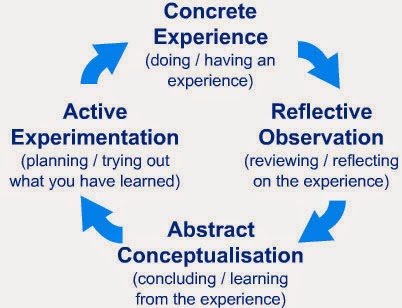 Concrete experience- This is when people start
learning when they are involved in the activity themselves.
Concrete experience- This is when people start
learning when they are involved in the activity themselves.
Reflective Observation- Some people like to
observe and while watching they start to learn.
Abstract conceptualisation- This just means
some people like to work it out for themselves in the head first.
Active experimentation- Last but not least some
people like to try out new ideas until they find the right way of doing it. I
would call this the trial and error method.
I personally think I observe
something first but then would definitely want to try it out for myself, I’m
not the type of person that will sit there and think about something I like to
have a go for myself and be hands on so I know how it feels and how it would affect
things.
Multiple Intelligences
The next subject I am going to talk about is multiple intelligences, I found this section really interesting as I have never looked into this before. I researched all types of intelligences and while reading up on a few I thought of people I knew who I could slightly connect it too. Howard Gardner broke down the idea of engaging and learning even more than David Kolb, he made known that there was different ways to be intelligent:
- Spatial- knowing what is going on around you, this type of intelligence means a person is very switched on and aware of the situation they’re in.
- Verbal-linguistic-this type of person loves to read, write and learn new things. They are very talented with words and are very good at explaining things, also they can pick up languages easier than others.
- Logical-mathematical- being good at maths, number and patterns. Working out complex calculations in their heads and connecting things together.
- Bodily-Kinaesthetic- like to use the body, sense of touch is extremely important, they tend to notice different textures. They are good at sports and exercise and like to express themselves using hand gestures.
- Musical- understand and appreciate musical rhythm and patterns, also enjoy playing musical instruments.
- Interpersonal- understand people and their relationships, being able to communicate and interact with people, they enjoy relationships at work and at home.
- Intrapersonal- having the appropriate reaction and attitude to other people and their situations, normally enjoy meditation, praying, good at visualisation, good at problem solving and helping with people’s emotions.
- Naturalistic- this type of intelligences are in tune with nature, nurturing and exploring the environment, learning about species, subtle changes in their environment.
This theory comes in handy as it helps us understand there
is many more ways to look at a piece of experience, and the process of turning
it into something we can reflect on and learn something new. This shows us many
ways to engage this process and how there are different ways to learn. We can
all see a piece on information but we would all read it and process it in
different ways. Gardner had this idea of multiple ‘lenses’ which meant we all
see things multiple ways and learn from it differently.
Learning
When people are learning something new, it is important to
think about is what frame of mind they’re in. If they are negative it can
really effect on how they look upon something and can block learning. Also past
experiences are crucial as what has happened in the past has made us who we are
today so we are more sensitive with certain situations and feel certain things
are important which someone else might not feel is.
Reflection-in-action and Reflection-on-action
Reflecting on something that has happened is very
important, but when you reflect on it is also an interesting subject. Donald
Schon (1987) introduced us to an idea of ‘reflection-in-action’ and
‘reflection-on-action’ the difference being ‘reflection-IN-action’ means
reflecting there and then in the situation, dancers are very good at this as
while dancing can feel something isn’t right and can experiment while
performing a sequence of steps until they find the right movement they like.
‘Reflection-in-action’ normally happens with a full involvement way of working.
Whereas ‘reflection-ON-action’ happens for more academically careers, this is
when someone looks back on something, and analyses it after it has happened.
Both types of ways of reflecting are very helpful, but ‘reflection-in-action’
is more effective as time always has an impact, we are only humans and we
forget certain things, or forget how we felt in that precise moment in time etc...
Having to wait until you reflect on something is hard and having to think back
and correct something for next time, you have to remember as much as you can. Reflection-in-action
is harder to achieve but is more powerful as you are in the moment and you have
to multi-task technically, think on the spot and change it, you have to go with
your gut feeling and take the risk.
On-line and Off-line
Robert Kottcamp also introduced the idea of
reflection-in-action to ‘on-line’ and reflection-on-action to ‘off-line.’ He
also believed that on-line was much harder accomplished and had a bigger effect.
Reflection-on-action/off-line is slightly like an afterthought and you are
looking back on what happened.
For a dancer it would be extremely hard to wait until the
evening or the following day to correct their steps they did yesterday, having
to remember what you did before and how to improve it. Another valid point
would be a dancer choreographing her own dance is a sole collector which means
it is her own work and it is her personal opinion what steps she likes and what
steps she puts into her dance, it is her choice and is her own person opinion
weather she likes her dance or not. Everyone else would have their own opinions
and like different sections or not like the style of dance maybe. When dancing
and reflecting-in-action also brings us to tacit knowledge, which is expressing
what you feel without speaking and showing it with your body, it is in your
choreography.
Tacit Knowledge and Muscle Memory
Tacit knowledge is having an understanding of the
importance of using natural instinct and trusting your own beliefs in the art
form, different types of artists use this in their work weather or
choreographing or not. Another peculiar feeling for a dancer is muscle memory,
it is natural instinct to put our body in that position or remembering a sequence
of steps. We don’t think about it, it just happens. I remember being at
college, I was constantly relied on to remember routines or dances as that was
one of my stronger abilities, but I always use to panic and my mind would be
blank, but as soon as the music came on somehow it would all come flooding back
to me and my body would natural remember it, but if you had asked me to explain
the steps to you, I would of found it impossible. Everything we know and feel
is through using our bodies, ears, eyes, brain, muscles it is the framework or
our world.
Muscle memory is an incredible tool to have, but after
researching more into I found out it cannot be some handle too. The saying
‘practice makes perfect’ is slightly true if you practice well then it is very
helpful, but if you keep practicing again and again when you are tired and keep
making the same mistakes your body starts to remember the mistakes and it
becomes a habit, practicing poorly is useless and does not help at all.
Journal Reflection
I have recently been writing in my journal and at first I
found it awkward and hard to come up with idea’s to write about, but gradually
I have come to grips with it. It is not just about writing what has happened to
you, but how you felt, would you do something differently, what if, planning
for an upcoming event, writing your own personally aims. Expressing your
emotions and feelings in a notebook is really rewarding and sometimes it is
nice to let off steam after a stressful day at work. Reflecting on a daily
basic has made me appreciate more and I actually have more of an understanding
as you actually reflect on what you learn so it has more of an effect on you, I
find I challenge myself more with small goals at the end of the week and I feel
I have been building on my own perception. After all reflection is just made up
of feelings, emotions, and decision making. I have also found my own personal
way of writing in my journal and not only using words to express and reflect
but writing in different colours, using capital letters where appropriate,
exclamation marks, images and little sketches in the corners even if they are
just little doodles they normally can explain the way I was feeling that day.
Another useful way of reflecting is working in a pair or
group which can lead to discussing and confronting each other. Hearing
different opinions is always good and can be a breath of fresh air which brings
new ideas. We are all different at the end of the day and maybe the way we read
and interpret something can be different to the way someone else would.
I was reading an interesting article about journal writing
and how we normally write in our diaries or journals in the evening when the
main events of our days have been and gone so our true emotion at the time has
faded. It is nearly impossible to be able write in your journal though-out the
day with the busy lives we live but if we could you would get our true
emotions, in the heat of the moment, when our emotions are at their highest
when we are most vulnerable. This also brings me to my final point of privacy
especially when writing in our journals, expressing our inner most thoughts and
things we wouldn’t dream of saying out loud has a large amount of danger to
hurting people around us. We cannot leave it in reach of others, or on the
other hand when writing in your journal think would you want a teacher, boss or
friends reading this, and if this did happen how would they react?
Conclusion
Over all learning from experience is something everybody
does in life, but you have to reflect and analyse what you have learnt and
making sure you learn from mistakes and also knowing your next step is
important. We should always be learning something new in life weather it is in
your career subject or everyday life.
Wednesday, 3 December 2014
What do children enjoy about dance?
Recently I have been wondering what do children enjoy about dancing, and as lots of children do lots of classes I wanted to find out which one is most popular and why? Is it the uniform? The music? The teacher? The style of dance? Their friends are in that class? There are many possible reasons why a child enjoys a certain class or why someone wouldn't enjoy a specific class and I would like to look into this with more detail. I know each child will have different opinions and enjoy different genres of dance, but normally the most common class is street, I know this by looking at the registers and looking at how many children attend shows me it is very popular.
Sunday, 30 November 2014
How exams effect children differently
I was teaching last night and while rounding up the children to start their barre work, I over heard a group of girls talking about exams and how some really enjoyed them and how others felt they didn't perform to their best standard while feeling under pressure in an exam. Some of us are better at living up to expectations when under pressure than others, and lots of children react differently in certain situations.
Sometimes we have tears before they go in if they get too worked up and start to panic before they go in, others tend to go very quiet, and you also have the type of children they will over practice just before an exam and run all their classwork over and over again in panic mode.
When I am in an exam helping with music it is also very interesting to see how some children that don't perform in class all of a sudden perform in an exam which is also nice to see, but others can obviously do the opposite, and not perform in an exam. I find lots of children make little mistakes in exams just with the nerves but most of the time children come out and say it wasn't as bad as what they thought it would be. At the end of the day the examiner is there to see their best qualities and help them work or certain things they are weaker on. I might go into how children behave differently in exams, and find out more about what children do and don't like about them and compare exams with actually performing on stage as lots of children react differently to going on stage too but always have the same type of emotions or panic as well.
Sometimes we have tears before they go in if they get too worked up and start to panic before they go in, others tend to go very quiet, and you also have the type of children they will over practice just before an exam and run all their classwork over and over again in panic mode.
When I am in an exam helping with music it is also very interesting to see how some children that don't perform in class all of a sudden perform in an exam which is also nice to see, but others can obviously do the opposite, and not perform in an exam. I find lots of children make little mistakes in exams just with the nerves but most of the time children come out and say it wasn't as bad as what they thought it would be. At the end of the day the examiner is there to see their best qualities and help them work or certain things they are weaker on. I might go into how children behave differently in exams, and find out more about what children do and don't like about them and compare exams with actually performing on stage as lots of children react differently to going on stage too but always have the same type of emotions or panic as well.
Professional networks task 3a
I like to think me and my work collages have a good working relationship, we all communicate via our phones mostly but with texting, phone calls and whatsapp more recently, as where I live I pick up a strong French connection so it is easier for me to use my wi-fi on whatsapp. When it comes to transferring music or larger documents with different notes for dances etc... We use emails. Also having Facebook is extremely helpful, if our local dance school posts information online we normally see it on our home page (and is always good for remembering each other's birthdays too!) Even though we are all different ages varying from 22 up to 60 we all get on very well, and spend a lot of time going for dinners after shows or gatherings back at the boss's house especially over the summer. It is also interesting on how we all rely of technology to communicate, my boss's husband is a producer and works up in London during the week days so they obviously communicate via phones and emails too, they both have a lot of work over pantomime season and know many famous names too which is always exciting to hear the latest gossip!
I was discussing how the internet has become such a big thing, and how our lives revolve around it now with my parents earlier. My parents have their own business and they get all there new customer's through their website now which apparently was never the case when they first started. They found it difficult keeping up with the times and designing their own webpage, Facebook and twitter but it has opened many new doors for them and their company is much bigger now.
I also stay in touch with my ballet teacher and she is an incredible women, she is now in her 70's and is still running her own dance school. We always send birthday cards and Christmas cards to each other and she was their to watch my first performance at college which meant a lot to me. She recently rang me to tell me about a new job in Hong Kong which I might want to look into and to tell me how the new RAD ballet syllabus is beautiful.
I went to a performing arts college in Hertfordshire and made so many life long friends and we always try our best to stay in touch as we live all over England and even different countries. We meet in London on occasions or we are all having Christmas dinner together this year too which I am looking forward to as well. One of my good friends found me a job being a dancer in a hotel out in Egypt but I had already said yes to my teaching job which I enjoy so much. We all communicate via texting, phone calls, whatsapp, Facebook, instagram and snapchat.
I have a very good friend who I have known since secondary school and we both went to different dance schools when we were younger and she is also now a dance teacher. She helped me a lot when I was looking for a teaching job and actually got me a job at the school she was teaching at too unfortunately she left but now has a very exciting life in Abu Dhabi teaching ballet to children out there. I was extremely sad when she told me she was leaving as I use to see her every day of the week, but which technology its not too hard having her away, we whatsapp, snapchat and Skype. Skype is incredible it is as if you are with the person face to face, we can spend hours catching up some evenings.
She found it hard to come to terms with the world out there as it is very different to ours, she was use to wearing shorts, strappy t shirt, skirts, and short dresses in the day but there are certain rules in countries such as Abu Dhabi where she had to be careful, and now has to cover her shoulders and make sure she wears clothes that cover her body which is hard bearing in mind it is a very hot country. She had to adapt to Abu Dhabi way of life such as no dancing in public (only in night clubs and in your own home,) no drinking and driving, and you can't show affection in public unless married and you can only hold hands if you're married nothing more. I know she had her friend come visit her who was a boy and there was a slight problem with her land lord excepting they were sharing an apartment together and not married even though he was sleeping on the sofa and she was in the bedroom. You can also be fined a lot of money is you are caught with a dirty car, and she now washes her car once a week.
I was discussing how the internet has become such a big thing, and how our lives revolve around it now with my parents earlier. My parents have their own business and they get all there new customer's through their website now which apparently was never the case when they first started. They found it difficult keeping up with the times and designing their own webpage, Facebook and twitter but it has opened many new doors for them and their company is much bigger now.
I also stay in touch with my ballet teacher and she is an incredible women, she is now in her 70's and is still running her own dance school. We always send birthday cards and Christmas cards to each other and she was their to watch my first performance at college which meant a lot to me. She recently rang me to tell me about a new job in Hong Kong which I might want to look into and to tell me how the new RAD ballet syllabus is beautiful.
I went to a performing arts college in Hertfordshire and made so many life long friends and we always try our best to stay in touch as we live all over England and even different countries. We meet in London on occasions or we are all having Christmas dinner together this year too which I am looking forward to as well. One of my good friends found me a job being a dancer in a hotel out in Egypt but I had already said yes to my teaching job which I enjoy so much. We all communicate via texting, phone calls, whatsapp, Facebook, instagram and snapchat.
I have a very good friend who I have known since secondary school and we both went to different dance schools when we were younger and she is also now a dance teacher. She helped me a lot when I was looking for a teaching job and actually got me a job at the school she was teaching at too unfortunately she left but now has a very exciting life in Abu Dhabi teaching ballet to children out there. I was extremely sad when she told me she was leaving as I use to see her every day of the week, but which technology its not too hard having her away, we whatsapp, snapchat and Skype. Skype is incredible it is as if you are with the person face to face, we can spend hours catching up some evenings.
She found it hard to come to terms with the world out there as it is very different to ours, she was use to wearing shorts, strappy t shirt, skirts, and short dresses in the day but there are certain rules in countries such as Abu Dhabi where she had to be careful, and now has to cover her shoulders and make sure she wears clothes that cover her body which is hard bearing in mind it is a very hot country. She had to adapt to Abu Dhabi way of life such as no dancing in public (only in night clubs and in your own home,) no drinking and driving, and you can't show affection in public unless married and you can only hold hands if you're married nothing more. I know she had her friend come visit her who was a boy and there was a slight problem with her land lord excepting they were sharing an apartment together and not married even though he was sleeping on the sofa and she was in the bedroom. You can also be fined a lot of money is you are caught with a dirty car, and she now washes her car once a week.
Subscribe to:
Posts (Atom)